By Iftikhar Ahmad
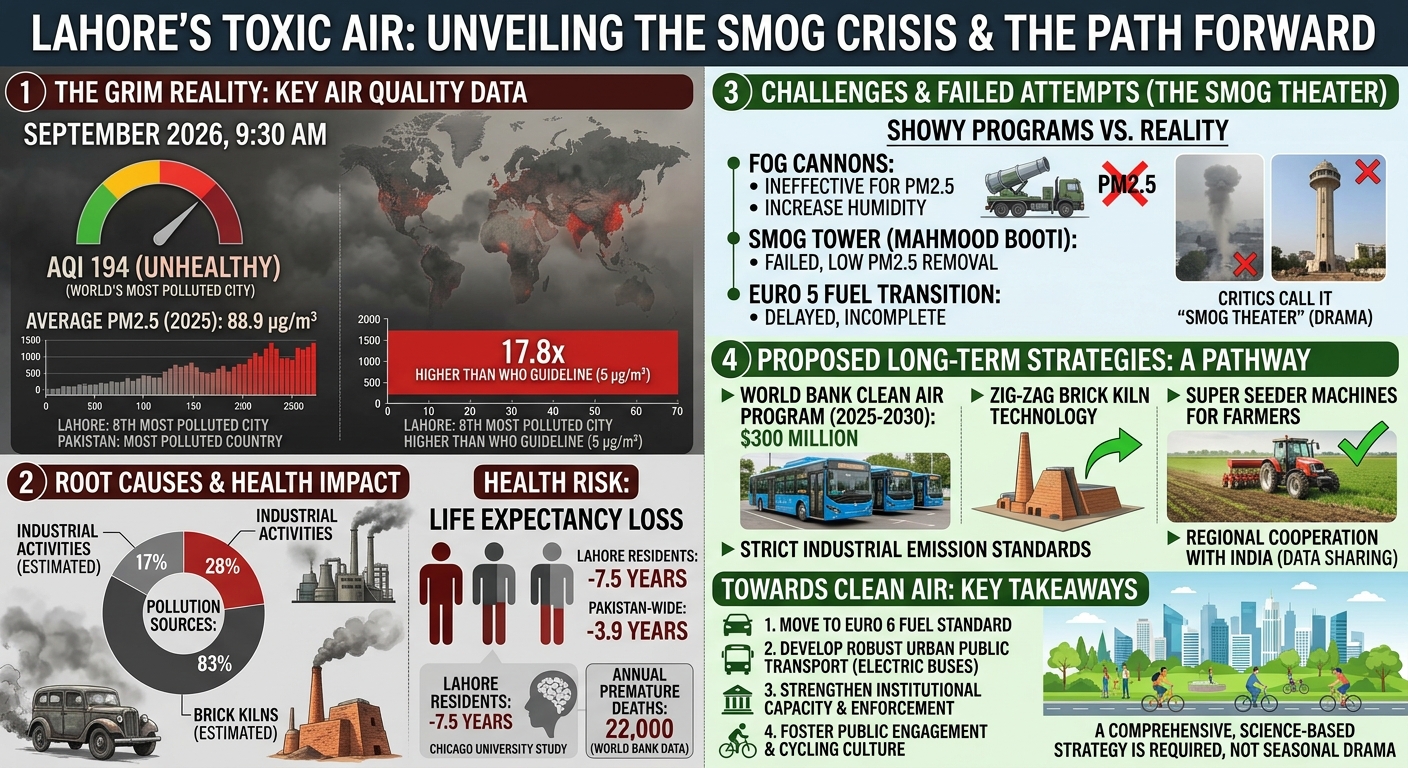
Lahore’s air is poisoned, and this poison is descending into the lungs of the city’s 13 million residents with every breath. At 9:30 AM on a September 2026 morning, Lahore’s Air Quality Index reached 194, which is classified as extremely unhealthy, and at that moment the city rose to the number one position on the list of the world’s most polluted cities. This is not an accidental occurrence but the logical outcome of a continuously deteriorating situation. In 2025, Lahore’s average PM2.5 concentration was recorded at 88.9 micrograms per cubic meter, which is 17.8 times higher than the World Health Organization’s annual guideline of 5 micrograms per cubic meter, and in that same year Lahore ranked 8th among the world’s most polluted cities while Pakistan was declared the world’s most polluted country. Data from global air quality monitoring agencies shows that PM2.5 levels in Lahore have been consistently rising over the past 5 years and have not come close to the World Health Organization’s safest guideline in any single year.
The roots of this crisis are deep and spread across multiple dimensions. The primary sources of Lahore’s air pollution include vehicular emissions, industrial activities, brick kilns, construction dust, and the burning of crop residues. In a detailed ruling, the Lahore High Court has acknowledged that vehicles contribute approximately 83 percent of the city’s local air pollution. These figures are evidence of how private vehicles and an obsolete transport system have caused irreparable damage to the city’s atmosphere. According to research published in a scientific journal, approximately 90 percent of Lahore’s annual emissions come from the transport sector, including nitrogen oxides, carbon monoxide, and fine particulate matter.
According to a comprehensive report by the Pakistan Institute of Development Economics, the number of registered vehicles in Lahore has exceeded 7,353,000, including 5,134,000 motorcycles, 1,653,000 motor cars, and 225,000 rickshaws. A large portion of these vehicles run on obsolete engines and poor-quality fuel, causing each vehicle to emit several times more pollution than normal global standards. According to research by the University of Chicago’s Air Quality Life Index, due to air pollution, residents of Lahore are losing 7.5 years of their expected life, while across Pakistan this loss is 3.9 years.

Air pollution experts have warned that during winter, due to the process of temperature inversion, pollution becomes trapped near the surface, which is why from October to February Lahore’s air becomes most toxic. During this period, the upper layer of air becomes warm and the lower layer becomes cool, which stops vertical air movement and pollution spreads over the city like a blanket. The monsoon season from July to September is the only period of natural relief when rain and greater air movement help cleanse the pollution, but as soon as the monsoon departs, the situation begins to deteriorate rapidly again. In November 2024, Lahore’s Air Quality Index approached 1,900 and in Multan it exceeded 2,000.
To deal with this serious situation, the Punjab government has announced several important measures, among which the 300 million dollar Punjab Clean Air Program with the cooperation of the World Bank is prominent. This program aims to reduce PM2.5 exposure in the Lahore Division by 35 percent from 2025 to 2030 and includes measures to reduce emissions in the transport, agriculture, and industry sectors. According to World Bank documents, under this program an investment of 300 million dollars will be made, including the phasing out of old vehicles in the transport sector, improvement of fuel quality, transfer of clean technology to industries, and alternative management of agricultural residues. The government has initiated action against old vehicles, planned to introduce 1,000 electric buses, and claimed to have converted all brick kilns to zigzag technology.
In the Lahore High Court’s ruling, it is recorded that all active brick kilns in Punjab have been converted to zigzag technology and each kiln has been issued a unique identification number for digital monitoring by the Environmental Protection Agency. In the agriculture sector, the government has provided super seeder machines to farmers to prevent them from burning stubble, on which a 60 percent subsidy is being given and 819,000 rupees subsidy is provided per machine. The Punjab government has provided approximately 5,000 super seeder machines to farmers over the past 2 years, through which rice residues can be mixed into the soil and there is no need to burn them in the open.
But despite all these measures, Lahore’s air is not becoming clean, and the biggest reason is the government’s focus on exhibitionist programs while ignoring the fundamental problem of air pollution. The Punjab government has prepared a plan of 3,000,000,000 rupees under which 30 modern fog cannons will be installed on electric trucks. The fog cannon or anti-smog gun is a mechanical device that sprays water in the form of fine droplets into the air so that larger particles settle to the ground.
This technology has actually been used at mining and construction sites to control dust, and presenting it as a solution to urban air pollution is not scientifically correct. Scientific research has proven that the effectiveness of this method is linked to weather conditions and its performance drops rapidly when wind speed exceeds 2.5 meters per second. Its biggest flaw is that this technology can only control large particles called PM10, while the most dangerous and health-lethal particles in Lahore’s air are PM2.5, which penetrate deep into the lungs and enter the bloodstream, and these cannons can have no effect on them. This is why experts call it smog theatre, meaning a drama of fog.
A study from China shows that within 25 to 35 minutes after a fog truck passes, PM2.5 levels can actually increase by up to 13 percent because the added moisture accelerates chemical reactions in the air, creating more fine particles. China experimented with spray cannons in cities like Beijing and Xi’an from 2016 to 2017, but it was later proven that this did not lead to any significant reduction in PM2.5. China’s actual improvement in air quality came from the transition from coal to gas, enforcement of industrial emission standards, and the establishment of more than 2,000 monitoring stations. In India’s Delhi as well, spray cannons were used on a large scale after 2018, but there was no change in PM2.5 levels, and from 2021 to 2022 judicial circles also raised questions about their effectiveness.
The first smog tower installed in Lahore has also proven its failure. The Punjab Environmental Protection Agency formed a 9-member committee in January 2025 to assess the performance of the smog tower installed in Mahmood Booti. After several days of monitoring, the committee stated in its report that the smog tower’s performance in cleaning PM2.5 was recorded as extremely low, raising questions about the efficiency of its electrostatic dust collection system. The report noted that wind speed, humidity, and rain had a far greater impact on air quality than the smog tower. Experts identified poor voltage regulation, ineffective electrostatic electrode design, and inadequate filtration systems as reasons for the failure.
The failure to implement policies is due not only to technical reasons but also to deep systemic and governance issues. According to a World Bank report, under the Punjab Clean Air Program, a total of 490,000,000 rupees were allocated for the fuel quality testing laboratories project, but by June 2026 less than 5,000,000 rupees had been utilized, which is less than 2 percent. In contrast, billions of rupees are being spent on exhibitionist programs. This contradiction is clear proof that the solution to the fundamental problem is not included in the government’s priorities.
The Pakistan Institute of Development Economics report makes clear that although the legal framework, plans, and policies exist, effective implementation is a major challenge. According to the report, Pakistan has not yet achieved full transition to Euro 5 fuel standards, and even full transition cannot bring significant improvement in emissions. A more effective solution is transition to Euro 6 standards, which significantly reduces harmful emissions from vehicles. The report also pointed out that fines for farmers have proven ineffective and a comprehensive and coordinated strategy is needed.
At a policy seminar by the Sustainable Development Policy Institute, experts revealed that air pollution is reducing the average life expectancy of Pakistanis by approximately 4 years, while residents of Lahore have lost approximately 7 years of expected life. According to experts, transport emissions in Lahore are responsible for approximately 35 percent of pollution, followed by heavy industry at 28 percent and brick kilns at 17 percent. They made clear that burning crop residues is not the primary cause of year-round pollution, and transport and industry continuously produce pollution throughout the year. Experts emphasized the need for establishing an international airshed management forum and a regional data sharing mechanism between Pakistan and India, because isolated national responses cannot effectively combat transboundary smog.
The Lahore High Court, in its ruling on an 8-year-long case, has made clear that environmental protection and water conservation must be made a fundamental part of government decision-making. The court said that a complete solution to a complex problem like an environmental crisis is not possible through a single order or ruling, and development projects cannot be completed by causing irreparable damage to the environment and natural resources. This ruling reflects that the judiciary has also acknowledged the government’s failure and highlighted the need for continuous judicial oversight for policy implementation.
According to a report by the Pakistan Air Quality Initiative, Pakistan’s Supreme Court has for 3 decades recognized the right to a clean and healthy environment as a fundamental right to life under Article 9 of the Constitution. This judicial recognition began with the Shehla Zia case in 2014, and in 2024 in the Aamir Ishaq case the court introduced the concept of environmental constitutionalism. The report pointed out that in the Lahore Air Pollution case, the Lahore High Court established a Clean Air Commission in 2003, but after 3 decades Lahore’s air is still deteriorating further.
It is essential to determine responsibility for this crisis. The government’s responsibility is primary and foremost because it is the regulator, the overseer, and the administrator of public resources. But the public is also not free from responsibility. In actions such as the growing number of vehicles, unnecessary use of private vehicles, burning of crop residues, and burning of garbage in the open, public behavior plays an important role. However, the public’s responsibility is secondary compared to the government’s because it is the government’s responsibility to provide alternative facilities and legal pathways to the public. If public transport is not effective, people will use private vehicles. If a farmer does not find a cheap and easy alternative to burning stubble, he will be forced to burn it. If an industrialist does not receive a subsidy for the supply of clean fuel and technology upgradation, he will continue to use obsolete methods.
The Pakistan Air Quality Initiative report also includes that according to the World Health Organization’s 2021 guidelines, the annual average of PM2.5 is 5 micrograms per cubic meter, while Pakistan’s national standard is 25 micrograms per cubic meter, which is 5 times higher than the World Health Organization’s standard. This is why the health impacts of air pollution in Pakistan are among the highest globally. According to World Bank figures, outdoor air pollution in Pakistan causes approximately 22,000 premature deaths every year, including a significant loss of disability-adjusted life years.
The solution to this problem lies only in a comprehensive, long-term, and scientifically based strategy that addresses all aspects of traffic, industry, agriculture, energy, and public behavior together. In the transport sector, complete phasing out of old vehicles, raising fuel standards to Euro 6, expanding the network of electric buses, and providing effective public transport to reduce the use of private vehicles are essential. The Pakistan Institute of Development Economics report has proposed promoting a cycling culture in cities, making university students its initiators, encouraging ride-sharing services, and increasing urban greenery through Miyawaki forests.
In the industrial sector, replacing obsolete technology with clean technology, strict monitoring of fuel quality, and continuous testing of emission systems are essential. Experts at the Sustainable Development Policy Institute pointed out that China has reduced its air pollution levels by approximately 65 percent since 2012, which was made possible through coordinated governance and more than 2,000 monitoring stations. They proposed that Pakistan can adopt similar institutional methods. In agriculture, the supply of super seeder machines should be further increased and farmers should be encouraged to use alternatives to stubble burning. Experts proposed that the problem of burning crop residues should be solved not only through fines but through incentives and alternative uses such as bioenergy and industrial inputs.
For all these measures, political commitment, sustained financial investment, and strengthening of institutional capacity are fundamental prerequisites. If the government continues to rely only on exhibitionist programs and smog theatre, Lahore’s air will never become clean and the city’s residents will keep yearning to breathe. Global experiences show that a lasting solution to air pollution is possible only through solid policies, strict enforcement, and public participation, and this process spans years, even decades. Lahore also needs this long and sustained struggle, not seasonal dramas.